
Your running stride asks one leg to push off while the other absorbs force, again and again. Strength training for runners in Seminole can help build strength, balance, and functional movement to better manage those demands alongside your regular runs.
Running takes more than determination. Your whole body works to keep you moving, and strength work can complement your runs without turning every workout into another hard effort. Choose exercises that support your running and fit your schedule. This guide explains how runner-focused strength work addresses repeated forces, why single-leg balance matters, and how functional movements can round out your training. You’ll also learn what to prioritize and when coaching can help shape a plan around your goals.
Key Takeaways
- Use strength work to help your body handle the repeated push-off and landing demands of running.
- Learn how coached backward lunges can build useful strength for your stride.
- Prioritize single-leg movements to develop balance and control that carry over to running.
- Balance training effort with recovery so strength work supports, rather than competes with, your running.
- Focus on sound technique and functional movements to build a practical foundation for stronger runs.
1. Strength training and injury prevention
Strength training can help runners build tissue capacity for running’s repeated forces. It may also support balance, endurance, and functional movement. Running is a sequence of repeated jumps: one leg pushes the body forward while the other absorbs force. Strength work helps prepare the body for both parts of that cycle.
Think of each stride as a small landing followed by a push-off. Muscles and connective tissues manage that repeated demand throughout a run. Suitable strength exercises give those tissues another way to build capacity. This cannot make injuries impossible, but it can address one of running’s physical demands.
Strength training can help runners build capacity for running forces, improve balance, and support functional movement. It can also complement endurance and recovery by training areas that running alone may not challenge in the same way.
A coach can connect each exercise to the runner’s needs. Controlled strength work, for example, can train the push-off and landing roles in a stride. A trainer can observe your movement, adjust an exercise, and shape a session around your experience and running routine. Focus on technique first, and add difficulty only when you can maintain control.
Strength work should support running, not make every workout another hard effort. Your schedule, recent training, and recovery all matter when planning sessions. A busy parent fitting runs around work may need a different routine from someone with flexible training hours. A practical plan is easier to follow consistently.
Running groups can offer Seminole runners accountability and social connection, whatever their pace. But a running group may not include strength coaching. Consider running with a group for community and adding coached strength work as a separate part of your training.
Useful coaching follows a clear process: discuss your running goals, observe basic movement, choose relevant exercises, and adjust as you progress. For example, a coach may notice you lose control during a single-leg movement and modify the exercise. Thoughtful changes keep the focus on movement quality, not simply doing more.
For runners exploring strength training for runners in Seminole, the goal is preparation, not a guarantee against injury. Running repeatedly loads the body through push-off and landing. Purposeful exercises, sound technique, and a plan that leaves room for running and recovery can help address those demands.
How a trainer coaches backward lunges for runners
Reverse lunges are a useful exercise for runners. A trainer can coach the movement to develop lower-body strength while keeping each repetition controlled. Step one foot backward, then bend both knees. The front leg does much of the work as you lower and rise. This movement also gives a coach a clear opportunity to observe your balance, control, and alignment.
Coaching begins with a simple demonstration: the trainer shows the backward step, lowering phase, and return to standing. Then you practice without rushing. The trainer watches whether your front foot stays planted and your knee tracks in line with it. If the step feels unstable, they can adjust its length or slow the movement. Learn the pattern before adding challenge.
One useful position to watch is the front knee. At the bottom of the lunge, the front leg reaches about a 90 degree angle. The runner lowers only as far as they can maintain control. A trainer can cue a steady torso and an even, deliberate rise. Think of the movement like lowering and lifting a small platform, not dropping quickly and bouncing back. Smooth movement makes it easier to notice when balance or position changes.
A coach can adapt the exercise to your experience. A newer runner may start with a shorter step and a comfortable range of motion. If you already move confidently, you can practice a deeper, controlled lunge. The trainer observes each side and adjusts the movement as needed. There’s no need to take a bigger step if it compromises control.
For a working parent fitting strength work around runs, clear coaching helps keep practice focused. A trainer can set a manageable pace, give you time to reset between repetitions, and watch for fatigue that affects form. If you start wobbling or rushing, the coach can pause and return to a simpler version. Quality matters more than squeezing in extra repetitions.
Progress can come from refining the same lunge before changing the exercise. Aim for a quieter step, steadier balance, and consistent knee position on both sides. The trainer can then decide whether to repeat that version or introduce a modest challenge. This step-by-step approach keeps the exercise relevant without turning it into a test.
If you’d like a coach to observe your movement, explore a guided training trial as a practical next step.
Trainer-guided balance and single-leg strength for runners
Running supports you on one leg at a time, so single-leg practice has a clear connection to your stride. A trainer can use that connection to choose movements that challenge balance and strength together. The goal isn’t to copy a running stride in a training session. It’s to practice controlling your body while one leg supports you.
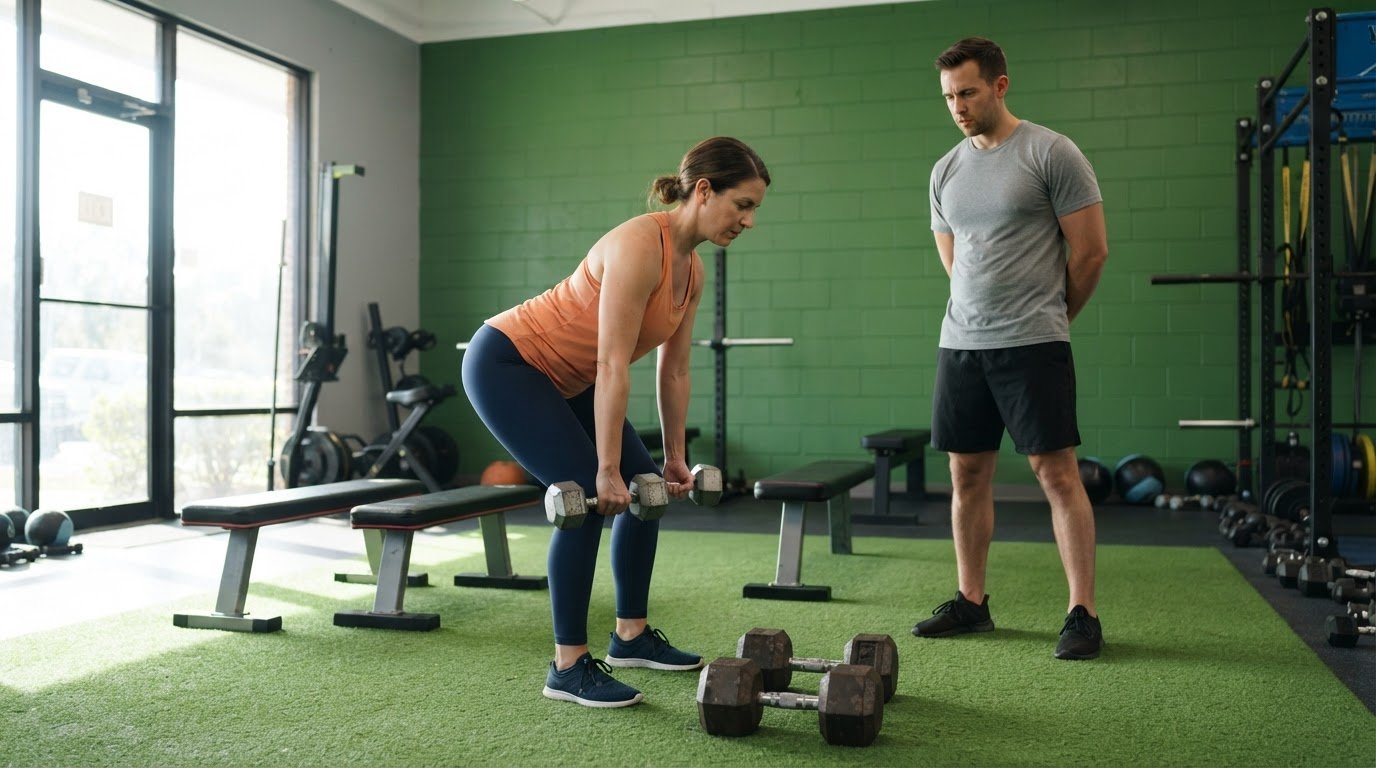
A single-leg rear deadlift is one exercise a trainer may use. The coach can demonstrate it, then observe your balance as you tip your torso forward and reach one leg behind. Focus on a steady standing foot and a controlled return to standing. If you wobble or rush, the trainer can reduce the range of motion or offer support while you learn the movement.
Balance and strength are related, but they aren’t identical. You might manage a two-leg movement comfortably yet feel less steady on one side. A trainer can compare sides, notice where your control changes, and tailor the exercise. If one leg repeatedly wobbles during a rear deadlift, for example, the coach can reduce the reach and help you build control before progressing.
Single-side work also helps make training more specific. The article’s author recommends that runners perform single-side exercises for at least 50% of their workout. A trainer can apply that idea by selecting movements that work one side at a time, while keeping the session suited to your experience and goals. The percentage is a recommendation, not a reason to force a movement that loses control.
Coaching brings attention to details that can be easy to miss on your own. A trainer can watch whether your hips shift, your standing foot rolls, or your torso twists during a repetition. A simple cue, such as reaching your free leg back more slowly, can help you reset. The coach can then observe the next repetition and adjust as needed.
Progress doesn’t have to mean adding weight. First, aim for steadier balance, smoother movement, and similar control on both sides. Once that looks consistent, your trainer can increase the challenge. This gives busy runners a clear focus without making every session complicated.
Single-leg strength work can complement running because each stride involves support from one leg at a time. A trainer-guided rear deadlift is one practical movement to discuss when shaping a session. The coach can choose a suitable version, observe your movement, and focus on useful control rather than a difficult pose.
4. Endurance and recovery
Running develops cardiovascular conditioning, but your heart and lungs aren’t the whole picture. Your body also handles biomechanical demands with every stride. Strength training for runners Seminole can complement endurance by challenging the muscles that help you move, while recovery gives your body space between demanding efforts. A coach at TrYumph Fitness considers both when planning training.
A trainer can schedule strength sessions around your running by considering run intensity, distance, and recovery. A demanding run and a challenging strength session may compete for energy if scheduled too close together. The coach can map your week, identify harder and easier sessions, and place strength work where it fits your overall training load.
Your plan should reflect your real calendar, too. A working parent with early runs and busy evenings may need a different weekly rhythm from someone with more flexible hours. A trainer can account for those commitments and help create a repeatable schedule, rather than adding sessions wherever there happens to be space. Consistency starts with a plan that works in everyday life.
Endurance training and strength work challenge your body in different ways. Running develops cardiovascular conditioning through sustained movement, while strength exercises challenge muscles through controlled resistance or bodyweight movements. A coach can balance these demands so that strength sessions support your running plan instead of adding fatigue without a clear purpose.
The author suggests runners can incorporate a 20-30 minute HIIT workout into their training. HIIT uses alternating periods of harder effort and easier recovery. A trainer can consider whether that option suits the runner’s current schedule and workload. It should fit alongside runs and strength sessions, not simply be added on top of every other demanding workout.
Recovery belongs in the schedule; it isn’t wasted time between workouts. A trainer can consider your energy, soreness, and recent sessions when deciding how challenging strength work should be. After a demanding run, for example, the coach may keep the next strength session controlled rather than pushing intensity. That helps the plan reflect the week you actually had.
For busy runners, a clear weekly outline makes decisions simpler. Your trainer can prioritize runs that support your main goal, then fit strength sessions around them. The coach can also revisit the schedule when work, parenting, or training demands change. A plan that adapts to real life is easier to follow than one that ignores it.
When work, parenting, or other commitments change, your schedule must adapt. Running requires cardiovascular conditioning, and the rest of the body is also biomechanically involved. A coach can use that perspective when revisiting the weekly outline, keeping endurance and strength work in view together rather than treating either as separate from the runner’s overall load. When commitments affect the available schedule, the plan can still be adjusted around the runner’s sessions and recovery needs. Keeping the body’s movement demands alongside cardiovascular conditioning helps ensure the schedule remains connected to the runner’s needs.
How a trainer builds functional strength training for runners
Functional strength connects exercises to the demands of running and daily life. That means preparing more than your legs. A trainer can build a session around your glutes, hamstrings, calves, and quadriceps, while also including upper-body work. The aim is to prepare your whole body, not just one running muscle.
Useful exercises can include single-arm bent-over rows, reverse lunges, and single-leg rear deadlifts. Each challenges a different aspect of movement and control. A trainer can select variations that suit your experience and observe your technique before increasing difficulty. These exercises support strength and movement capacity, but they cannot guarantee injury prevention.
Technique comes before sets or repetitions, especially when you’re beginning. A trainer can start with basic movement patterns, demonstrate each one, and coach a comfortable range of motion. If balance affects your form during a single-leg movement, the coach can simplify it. Progress when you can move with control, not simply when you reach a target number of repetitions.
Which exercises can support running performance and injury prevention? A trainer may use reverse lunges, single-leg rear deadlifts, and single-arm bent-over rows, with an emphasis on controlled technique. The aim is functional strength for running demands, not a promise of an injury-free season.
For a beginner runner, a trainer can create a bodyweight plan that introduces exercises gradually and prioritizes movement quality. One available routine is designed to take 7 minutes, with each exercise lasting 45 seconds and a 15-second rest between exercises. As runners get stronger, they can perform two rounds for a total of 14 minutes.
A bodyweight routine can also make home sessions convenient, without relying on equipment. A trainer can demonstrate the movements, tailor the routine to the runner’s ability, and suggest trying it after a run 1-2 times per week. The runner still needs a schedule that fits recovery and other training demands.
Functional work can extend beyond running, too. Strength supports everyday tasks such as carrying groceries, as well as activities like pickleball. Alberto Salazar said seven hours of gym training per fortnight helped Mo Farah more than running 110 miles a week on the road. The takeaway isn’t to copy an elite athlete’s workload. It’s to give strength a deliberate place in a balanced plan.
For coached guidance that connects strength exercises with your running goals, explore a training trial.
TrYumph Fitness
TrYumph Fitness can help you turn these ideas into a strength routine that fits your goals and schedule. Personal Training provides individual coaching on exercise technique and a practical plan. Small Group Training combines coaching with community support.
Consider coaching if you’re unsure how to balance strength sessions with runs, want movement feedback, or need a manageable routine alongside work and family commitments. The aim is steady, thoughtful progress that complements your running, not a plan that adds unnecessary pressure.
If you’re ready to talk through your running and strength goals, contact TrYumph Fitness.
Build your next step around the runner you are today
Your training should fit the miles you run, the time you have, and the goals that matter to you. Start with a clear priority, such as feeling steadier during single-leg movements or fitting strength work into your weekly routine. A coach can use that goal to shape your next step without asking you to overhaul your schedule all at once.
For strength training for runners in Seminole, a thoughtful plan can make strength work part of your running life, not another demand competing with it. Start with an approach you can follow consistently and adjust as your running changes. You don’t need every detail figured out before you begin.
Ready to talk through your goals and explore a training option? Connect with TrYumph Fitness about getting started. Take the next step at a pace that feels practical, and keep building toward stronger, more confident runs.
Frequently Asked Questions
Which gyms, trainers, or physical therapy clinics in Seminole offer strength training for runners?
TrYumph Fitness offers Personal Training and Small Group Training for runners in Seminole, as well as Largo, Clearwater, Pinellas Park, Indian Rocks Beach, and Madeira Beach. These options provide fitness coaching, not physical therapy. For injury assessment or rehabilitation, seek care from a licensed healthcare professional who provides those services.
What are the risks of strength training for runners, and how can injuries be prevented?
Rushing through exercises, using poor technique, or adding too much training alongside runs can strain muscles or aggravate discomfort. Tell your trainer about your running schedule and any current discomfort before a session. Start with movements you can control, and stop an exercise that causes pain. For persistent or worsening symptoms, consult a healthcare professional rather than training through them.

Article by
Coach Matt O'Brien
Coach Matt O'Brien is the founder of TrYumph Functional Training and TrYumph KidFit, where he has helped thousands of adults, children, and families build stronger, healthier, and happier lives through science-based health coaching, personal training, and small group training since 1998. With more than 25 years of coaching experience and over 25,000 hours working one-on-one and in small-group settings, Matt specializes in helping busy adults improve strength, energy, weight loss, nutrition, and long-term health through practical, sustainable lifestyle change.
Matt is a National Board Certified Health & Wellness Coach (NBC-HWC), Certified Strength and Conditioning Specialist (CSCS), Precision Nutrition Level 1 Coach (PN1), and Master Health Coach. His expertise spans strength training, nutrition coaching, healthy habit formation, performance optimization, and healthy aging, helping clients build resilience and enjoy a higher quality of life for years to come. He is also the author of THE MAGIC PILL and FITNESS FUEL (Cookbook) and is passionate about translating complex health and longevity science into simple, actionable strategies that busy people can apply in everyday life.
Through TrYumph KidFit, Matt is equally committed to improving kids fitness, confidence, athletic development, and lifelong healthy habits by creating fun, encouraging environments where children can thrive physically, mentally, and socially.
Matt's coaching philosophy is built on simple beliefs: movement is medicine, consistency beats perfection, and sustainable habits create extraordinary results. His mission is to help people live longer, healthier, happier lives through coaching, community, and caring.
When he's not coaching at TrYumph, Matt enjoys spending time with his wife and two sons, continuing his education in health and longevity science, and creating educational content that empowers people to take control of their health.